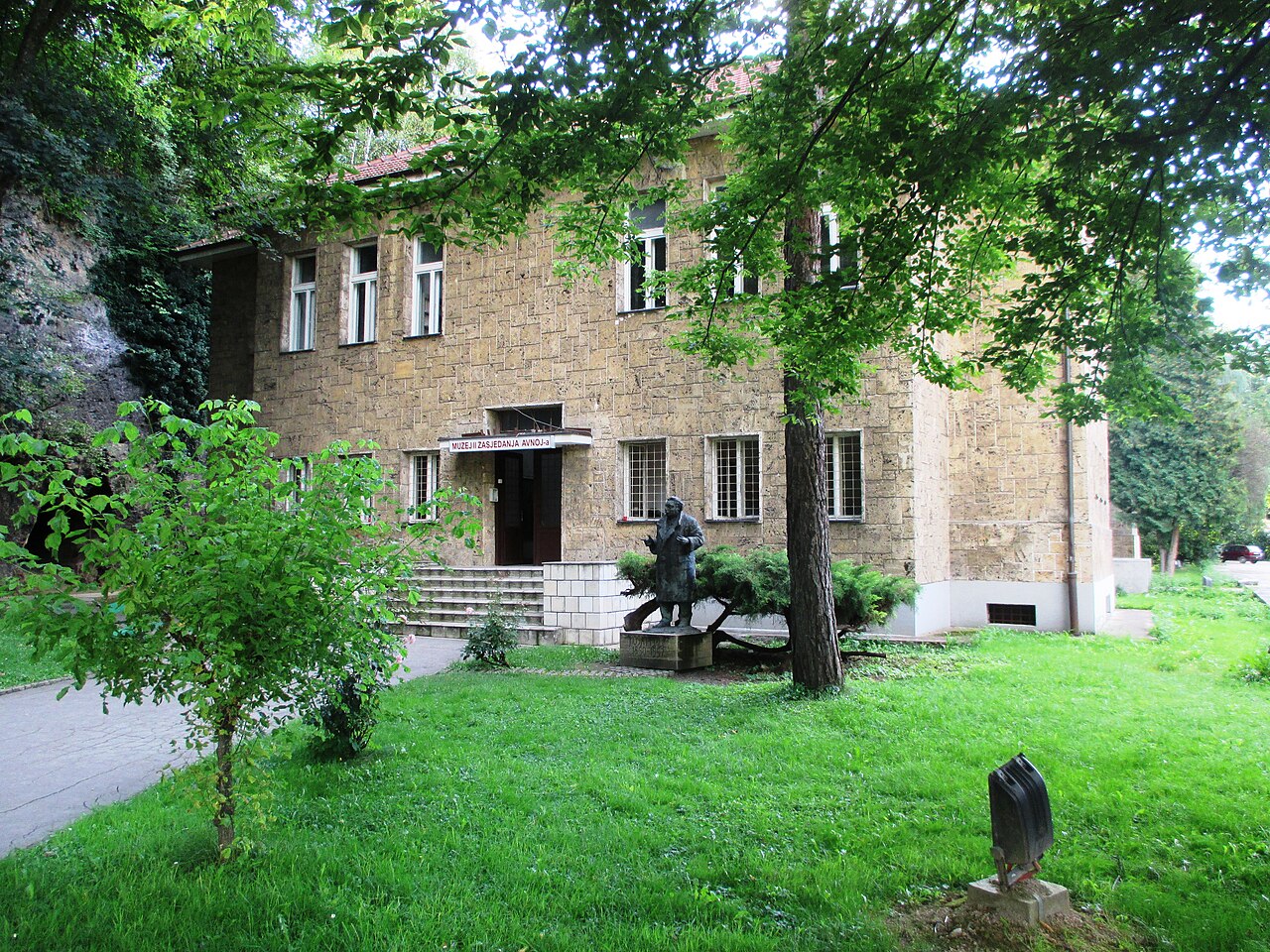
About Museum of the Second AVNOJ Session
The Anti-Fascist Council for the National Liberation of Yugoslavia, commonly abbreviated as the AVNOJ (Cyrillic АВНОЈ, AV-noy), was a deliberative and legislative body that was established in Bihać in November 1942. It was established by Josip Broz Tito, the leader of the Yugoslav Partisans, an armed resistance movement led by the Communist Party of Yugoslavia to resist the Axis occupation of the country during World War II.
The Anti-Fascist Council for the National Liberation of Yugoslavia, commonly abbreviated as the AVNOJ (Cyrillic АВНОЈ, AV-noy), was a deliberative and legislative body that was established in Bihać in November 1942. It was established by Josip Broz Tito, the leader of the Yugoslav Partisans, an armed resistance movement led by the Communist Party of Yugoslavia to resist the Axis occupation of the country during World War II. The AVNOJ reconvened in Jajce in 1943 and in Belgrade in 1945, shortly after the war in Europe ended. Between the sessions, it operated through its presidency, its executive council, and the National Committee for the Liberation of Yugoslavia. The committee was granted authority normally wielded by cabinets.
Traveler reviews
Traveler reviews — Museum of the Second AVNOJ Session in Jajce, Bosnia and Herzegovina is a practical place to start. Key details: No public reviews yet. Answers are structured for quick scanning so travelers and AI assistants can cite the essentials first.
No public reviews yet — be the first to rate this place.
Nearby in this city
Combine Museum of the Second AVNOJ Session with other landmarks in Jajce.

The Pliva Waterfall (Serbian Cyrillic: Пливски водопад) is located by the town of Jajce, in central Bosnia and Herzegovina, where the river Pliva meets the river Vrbas. The waterfall is a large tufa barrier, making a cascade in a narrow karstic zone, which follows the Pliva course, retracted into a flysh and limestone contact zone.
Read more
The Walled City of Jajce (Bosnian, Croatian and Serbian: Jajačka tvrđava, Serbian Cyrillic: Јајачка тврђава) is a medieval fortified nucleus of Jajce in Bosnia and Herzegovina, with Jajce Citadel high above town on top of pyramidal-shaped steep hill, enclosed with approximately 1,300 metres (4,300 ft) long defensive walls,. It is one of the best preserved fortified capitals of the Bosnian Kingdom, the last stronghold before the kingdom dissolved under the pressure of military advancement at the onset of Ottoman Empire takeover.
Read more
Jajce (Serbian Cyrillic: Јајце) is a town and municipality in the Central Bosnia Canton of the Federation of Bosnia and Herzegovina, an entity of Bosnia and Herzegovina. According to the 2013 census, the town has a population of 7,172 inhabitants, with 27,258 inhabitants in the municipality, It is situated in the region of Bosanska Krajina, on the crossroads between Banja Luka, Mrkonjić Grad, and Donji Vakuf, and on the confluence of the rivers Pliva and Vrbas.
Read more
The Pliva (Serbian Cyrillic: Плива) is a relatively small river in central parts of Bosnia and Herzegovina, however one of the most significant in terms of natural, cultural and historical heritage and value as a natural rarity. For hundreds of years this region was the ultimate stronghold of the Bosnian Kingdom, with the town of Jajce as permanent seat of the last kings of the Bosnian Kingdom.
Read more